AI automation, population growth, and real unemployment is creating a loop. It’s an economic reality that makes Universal Basic Income (UBI) necessary. For those of us paying attention, we already see UBI is underway.
The Self-Reinforcing Loop Nobody’s Talking About
We’re witnessing something unprecedented in economic history. Three massive trends are quietly reshaping our core economy. The foundation of how we work and earn is changing. When you connect these dots together, they reveal an unavoidable conclusion. Knowing these trends can also help you better prepare.
Check out my recent video on this topic. And feel free to comment with any questions.
Trend #1: AI and Automation Are Replacing Jobs Faster Than Ever
The pace of job displacement has accelerated. By 2025, roughly 85 million have already been displaced globally. That’s due to AI and automation, with the United States seeing a 22% increase in AI-induced layoffs in the past two years.
This isn’t your grandfather’s automation story. Agriculture dropped from 40% of the American workforce in 1900 to less than 2% today. However, AI is now reaching into white-collar jobs at unprecedented speed. By 2030, 30% of current U.S. jobs could be fully automated. On top of that, 60% will see task-level changes.
The jobs at risk reveal a troubling pattern:
- Customer Service: Customer service representatives face 80% automation rate by 2025
- Data Entry: 7.5 million jobs eliminated by 2027
- Entry-Level Positions: Nearly 50 million U.S. entry-level jobs affected
- White-Collar Work: McKinsey predicts 30% of hours worked will be automated by the end of the decade.
Tech leaders are openly talking about the scale of disruption. Sam Altman, CEO of OpenAI, noted that AI will automate entire industries. This means millions of jobs will disappear in the next decade. Elon Musk has also suggested that in a benign scenario, probably none of us will have a job.
But automation isn’t just destroying jobs. It’s also boosting productivity and extending human lifespans, which leads directly to our second trend.
Trend #2: More People Than Ever Are Competing for Fewer Jobs
The global population has exploded from 3.5 billion in 1970 to 8.2 billion today. But it’s not just raw numbers. We’re also better educated, and more connected than any generation in history.
Global literacy has climbed above 85%, and billions now have internet access through smartphones. This access to knowledge has sped up innovation. On top of that, it’s created more competition. Innovation creates new jobs, but not at the same pace it’s replacing them. Many of the new jobs require more time to learn as well.
The result? Student debt has surpassed $1.8 trillion as people invest more in education. This is just to remain competitive. And in some cases, it’s learning for jobs that may not exist by the time they graduate.
Trend #3: Real Unemployment Is Much Worse Than Official Numbers Suggest
The government and media tend to report the U3 unemployment rate. It’s currently hovering around 4.5%. But this metric excludes many people:
- Those who’ve stopped looking for work out of discouragement
- People forced into early retirement
- Students and workers pushed back into school
- Those on disability benefits
A more accurate picture comes from the labor force participation rate. This has been declining for 25 years, even during the longest bull market in U.S. history. Roughly 14% of all workers have already been displaced. And this has hit younger workers hard.
The Accelerating Feedback Loop
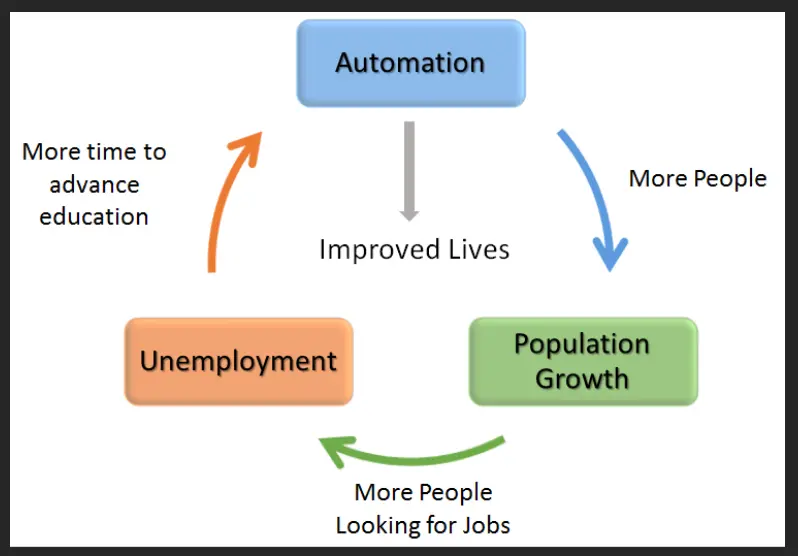
Here’s where these three trends create a self-reinforcing cycle:
- Automation creates abundance: More people can survive and thrive
- Population growth drives innovation: More minds solving problems faster
- Faster innovation accelerates automation: Fewer jobs available for more people
- Repeat and intensify
This loop is accelerating. AI is pushing this cycle faster going into the 2030s. And while the cycle speeds up, wealth concentrates at the top. Investors are seeing higher returns on capital. And average pay for workers has climbed at the same rate. Paired with new technologies, employees are more productive.
Why UBI Isn’t a Radical New Idea
The surprising truth? We already have a convoluted version of Universal Basic Income in America. The federal government runs over 80 welfare programs, spending $1.3 trillion annually. But this system is:
- Bureaucratic: Multiple layers of administration eat into benefits
- Inefficient: Some programs deliver as little as 50 cents per dollar spent
- Counterproductive: Welfare cliffs actively discourage people from working more hours
A Universal Basic Income would simply streamline what we’re already doing. Instead of 80+ programs with armies of administrators, give people money directly. It’d eliminate a lot of waste, put more in the pockets of people that need it, and let them decide how to use it best.
The government is also already the largest provider of jobs. The official numbers show 1 in 7 of all jobs are direct government jobs. But this doesn’t even include military or contract workers. On top of that, it doesn’t include all the private jobs that the government has created indirectly. For example, legal teams, tax accountants, compliance roles, etc. But I digress…
The Economic Case for UBI in an AI Era
The fundamental challenge is how to prepare for more automation and job loss. Automation and AI systems are a huge value creator for society. However, many of benefits are concentrating in the hands of top workers and investors.
Already, our current tax structure relies on taxing worker through income tax. But as jobs disappear, that revenue source shrinks when support needs growth. Investors and top employees can shift their increasing gains to lower taxed long-term capital gains.
Several economists and researchers propose taxing AI work instead of human work. But this is a bad idea. Lower costs to produce goods allows for companies to charge less, assuming they don’t have monopolies. It’d be better to figure out sharing value created in other ways.
On top of that, the companies benefiting from AI-driven automation will pay the majority of all taxes. This is directly and via their stakeholders.
The Timeline Is Shorter Than You Think
The question isn’t whether UBI will happen, but when. AI is helping speed up job replacement.
The World Economic Forum’s 2025 Future of Jobs Report shares some insight. On average, workers can expect that two-fifths (39%) of their existing skill sets will be transformed or become outdated. And that’s over the 2025-2030 period. They’re not waiting five years to start.
I’m just scratching the surface on the research behind these trends. If you want my updated ideas, feel free to sign up for my newsletter. I don’t publish often, but when I do, it’s packed with useful ideas. For example, I share where I’m investing my personal savings…
What This Means for You
The transformation is already underway. Workers aged 18-24 are 129% more likely than those over 65 to worry AI will make their job obsolete. Many entry-level positions are disappearing faster than we can create new ones. And this is just one of many issues for career advancement.
The solution isn’t to resist technology or hope for a return to the past. Don’t be a luddite!
A better solution is to embrace the labor saving technology. It’s already a net benefit for society. Instead, the question shifts from “how do we all find jobs” to “how do we help everyone benefits from the new productivity.”
The Path Forward for UBI
Universal Basic Income represents a pragmatic response. We’re seeing a new economic reality, one that needs to reimagine how we share value creation. Because without wealth in consumers hands, the entire system stalls.
Replacing the bloated welfare state with a streamlined UBI would:
- Reduce bureaucracy and administrative waste
- Eliminate welfare cliffs that trap people in poverty
- Provide security as the job market transforms
- Enable entrepreneurship and risk-taking
- Preserve consumer spending in an automated economy
The three trends driving us toward UBI show no signs of slowing. Automation continues, population and education levels keep rising, and real unemployment is climbing. It’s a self-reinforcing loop that’s concentrating wealth at the top.
Social and political tension is already rising due to this loop. And unfortunately, there’s entrenched politicians and third parties benefiting from the complex welfare state. However, there’s a growing crowd that sees this and knows a basic UBI is the better path.
It won’t be a perfect system, but could easily be a better one. One that better shares value created in society, while reducing bureaucracy and waste. I see plenty of issues with a UBI, but those are thoughts for another article.
Overall, once you see these three trends and how they connect, you can’t unsee them. The path to Universal Basic Income is inevitable. It’s an economic reality we’re already walking, but few have seen the trends.
The automation revolution is accelerating. Jobs are disappearing faster than most people realize. All the while, governments have been creating jobs for displaced workers. Roughly 1 in 4 jobs is a result of government.
Understanding these economic forces can give you an edge. The future of work is underway and you can better position yourself to stay relevant. On top of that, saving and investing is more important now than ever before.
If you want to see how I’m investing, feel free to sign up for my newsletter…