Gut supplements split into two philosophies, and these two products sit at opposite ends of them.
Seed DS-01 is the broad approach. Twenty four live strains, a prebiotic, and a capsule built like a delivery vehicle. Blueprint Essential Microbiome is the narrow approach. Two actives, neither of them alive, both chosen around one organism.
This article compares the two labels and the two prices. It is a label comparison, not a hands on review. I have not tested either product, and nothing here is sponsored.
The short version: Seed DS-01 gives you 24 live strains totaling 53.6 billion AFU, plus 400 mg of a polyphenol prebiotic, for $49.99 a month, subscription only. Blueprint Essential Microbiome gives you pasteurized Akkermansia at 10 billion TFU plus 300 mg of tributyrin, for $39, about $1.30 a day against about $1.67. Seed is the general coverage play. Blueprint is a targeted play on the one gut organism with a human trial behind its pasteurized form. Prices are as of November 2026. If you are new to Blueprint, you can get $50 off your first Blueprint order through this referral link, which is more than the price of the bottle.
The Biggest Trap: Reading Strain Count as a Score
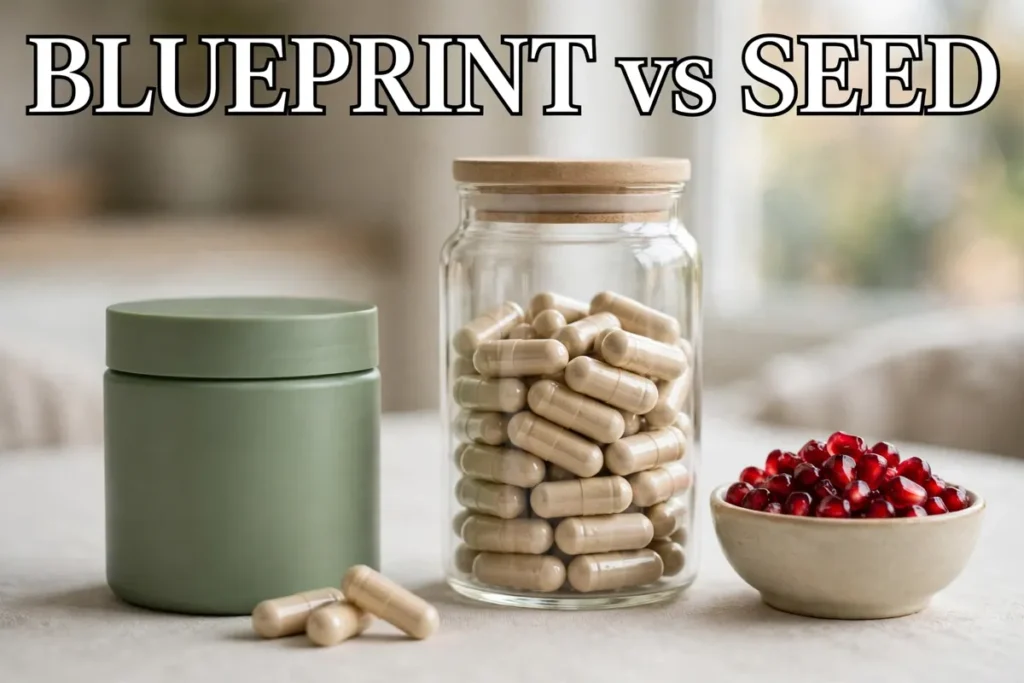
The trap is treating 24 against 2 as a scoreline. It is not, for two reasons a buyer can check.
First, the units do not match. Seed counts AFU, active fluorescent units, which are live cells. Blueprint counts TFU, total fluorescent units, which include non living cells, because its Akkermansia is pasteurized on purpose. Ten billion TFU and 53.6 billion AFU are measurements of different things. Adding them up side by side tells you nothing.
Second, the amounts are not equally visible. Blueprint prints both of its actives at full dose, 10 billion TFU and 300 mg. Seed names all 24 strains but gives their amounts by blend, not strain by strain. A buyer cannot read the Seed label and work out how much of any single strain they are getting, or match that strain to the dose used in its research.
Neither label is dishonest. They are just built to be read differently, and the strain count is the one number that should not decide this purchase.
The Two Labels, Side by Side
Amounts are per day, as printed on the current labels.
| Per day | Blueprint Essential Microbiome | Seed DS-01 Daily Synbiotic |
|---|---|---|
| Actives | 2 | 24 strains plus a prebiotic |
| Headline organism | Pasteurized Akkermansia muciniphila | Lactobacillus and Bifidobacterium blends |
| Alive on arrival | No, pasteurized | Yes, live cultures |
| Count | 10 billion TFU | 53.6 billion AFU |
| Second active | Tributyrin 300 mg | Prebiotic MAPP 400 mg |
| Amounts printed per ingredient | Yes, both | By blend, not per strain |
| Capsules per day | 1 | 2 |
| Capsule design | Delayed release | ViaCap, capsule inside a capsule |
| Refrigeration | Not required | Not required |
| How it is sold | One time or autoship | Subscription only |
| Price per 30 days | $39 | $49.99 |
| Cost per day | $1.30 | About $1.67 |
Two details deserve a plain statement. First, Seed contains no Akkermansia at all. Anyone choosing between these two over that organism is really choosing whether the organism matters to them, because only one label has it.
Second, Blueprint is not a probiotic, and the brand says so in its own wording, calling the product a source of zero active cultures. It is a postbiotic. Seed is a true synbiotic, live probiotic strains plus the prebiotic meant to feed them. The full Blueprint panel is in my Blueprint Essential Microbiome ingredients breakdown.
The Cost Math That Matters
This is the simple part. A month of Blueprint costs $39 bought once, or $37.05 on autoship, about $1.30 or $1.24 a day. A month of Seed costs $49.99, about $1.67 a day. The gap is $10.99 a month, roughly $132 a year at list prices.
The purchase models differ too. Seed sells DS-01 by subscription on its own site. There is no one time option to test a single month at list price. Blueprint sells the bottle outright, with autoship as a choice rather than the only door.
If you are a first time Blueprint buyer, the referral credit is the largest saving on this page. You can claim $50 off your first Blueprint order with a referral link, and since one bottle costs $39, the credit covers it. The discount applies at checkout, no code needed.
Breadth vs Focus: What Each Formula Is Trying to Do
Seed is built for coverage. Its 24 strains span the two genera most probiotic research uses, the outer capsule carries the prebiotic, and the inner capsule carries the live cultures, a design meant to get living organisms through the stomach. For a buyer who wants one general gut product and values strain diversity, the logic is easy to follow. The cost of that breadth is the blended dosing. Diversity is the claim, and no single strain can be audited against its studied amount from the label.
Blueprint is built around one bet. Akkermansia is a gut lining organism, and the pasteurized form is the version with human data. In the 2019 Nature Medicine trial on PubMed, 40 overweight insulin resistant adults took 10 billion Akkermansia a day for three months, live or pasteurized. The pasteurized group improved insulin sensitivity by about 29 percent against placebo and lowered total cholesterol by about 9 percent. The live form did not produce the same significant results. Blueprint’s dose and form match that pasteurized arm exactly, and its second active, tributyrin, is a butyrate source aimed at the same gut lining story. The cost of that focus is range. Two actives do two jobs, and nothing else.
Neither product has been trialed against the other, and Seed’s formula as a whole is not what its strain research tested. Read each label for the job it is actually built to do.
Testing: What Each Brand Puts in Writing
Blueprint states that this product’s ingredients undergo third party testing for purity and heavy metals, and the brand publishes batch reports across its line. For this specific bottle I could not locate a public batch report with measured values, so there are no figures to quote here. I explained how those reports work in Blueprint Third Party Testing.
Seed publishes extensive research and quality material on its strains and its delivery system. What it does not publish on the label is the per strain amounts, which remains the practical gap for a buyer trying to verify a dose. On both sides, the paperwork supports the quality story. Only one label lets you check every dose yourself.
Which Buyer Each Label Fits
Pick Seed DS-01 if breadth is the decision. You want live cultures, many strains, a prebiotic in the same capsule, and you are comfortable with a subscription and with doses you cannot split by strain.
Pick Blueprint Essential Microbiome if the Akkermansia research is the decision. You want the pasteurized organism at its trial dose, a printed amount for everything in the capsule, one capsule a day, and the option to buy a single bottle.
What to Look For on Any Probiotic Label
- Whether the organisms are alive at all, and which unit the count uses, CFU, AFU, or TFU.
- Amounts printed per strain or per active, not only as a combined blend weight.
- A prebiotic named with its dose, or its absence stated plainly.
- The delivery design, and whether it exists to keep live cultures alive.
- How it is sold, one time or subscription only, and the true cost per day.
- Testing or research you can open yourself, tied to the product in front of you.
Frequently Asked Questions
Is Blueprint Essential Microbiome a probiotic?
No. Its Akkermansia is pasteurized, so nothing in the capsule is alive. The brand describes it as zero active cultures, which makes it a postbiotic. Seed DS-01 is a probiotic, with 24 live strains, plus a prebiotic, which makes it a synbiotic.
Does Seed DS-01 contain Akkermansia?
No. Seed’s 24 strains come from the Lactobacillus and Bifidobacterium genera. Akkermansia is a different organism, and Blueprint is the only one of these two labels that carries it.
Which one has more bacteria?
The counts cannot be compared directly. Seed lists 53.6 billion AFU of live cells. Blueprint lists 10 billion TFU, a unit that counts cells whether or not they are alive, because its organism is pasteurized. They measure different things by design.
Which one is cheaper?
Blueprint, on price and on terms. It costs $39 for 30 days, about $1.30 a day, bought once or on autoship. Seed costs $49.99 for 30 days, about $1.67 a day, and is sold by subscription only on its own site. Prices are as of November 2026. A first Blueprint order is cheaper still, since the $50 referral credit is larger than the $39 bottle.
Does either product need refrigeration?
No. Both are shelf stable. Blueprint’s organism is pasteurized, so temperature cannot kill it, and Seed’s ViaCap format is built to keep its live strains stable at room temperature.
The Bottom Line
Seed DS-01 is the broad net: 24 live strains, a prebiotic, and delivery engineering, at the higher price and on subscription. Blueprint Essential Microbiome is the narrow spear: one pasteurized organism at its human trial dose, one supporting active, every amount printed, at the lower price and with no subscription required. The strain count makes Seed look bigger. The labels make them different tools.
If the Blueprint label is the one that fits, you can get $50 off your first Blueprint order here and put the credit toward your first bottle.
Related reading: