Creatine monohydrate might be the simplest buying decision in supplements. One molecule. One studied dose. Dozens of brands selling the same white powder.
Blueprint sells its version at $40 for 100 servings as of November 2026. Bulk brands sell the same compound for a third of that per serving. So what does the extra money buy?
This is a label and price comparison, not a hands on review. Every number comes from a product page, a Supplement Facts panel, or a published source you can check.
The short version: Both products are creatine monohydrate, and the research credits the molecule, not the brand. On price alone, generic wins: about 15 cents a serving for BulkSupplements against 40 cents for Blueprint. The premium buys a published batch test with measured values, a true 5 g dose per scoop, and one checkout if you already buy from Blueprint. New customers can get $50 off a first Blueprint order through a referral link, and that credit covers the entire $40 jar with money left over.
The Biggest Trap: Paying a Premium for the Molecule Itself
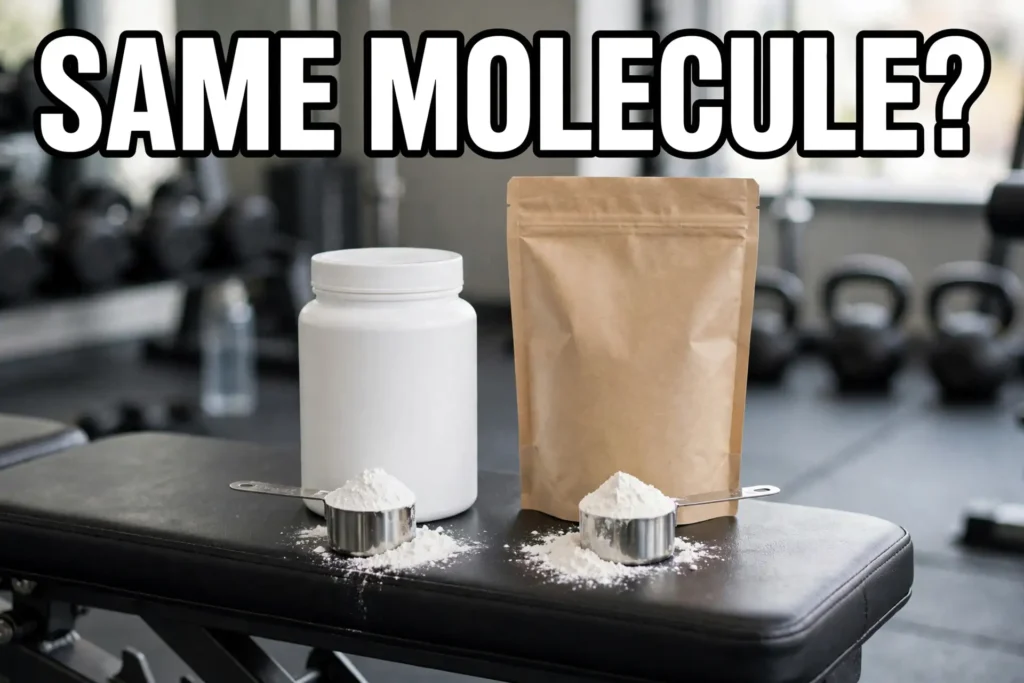
Creatine monohydrate is a commodity. The powder in a $40 jar and the powder in a bulk bag are the same compound. Any brand story implying its monohydrate outperforms another brand’s is unsupported by the research.
The reference document is the position stand of the International Society of Sports Nutrition. The ISSN position stand on creatine supplementation, by Kreider and colleagues (2017), concludes that monohydrate is the most extensively studied and clinically effective form of creatine, and that no alternative form has beaten it. Brand is not a variable in that conclusion.
Strip the branding away and three differences remain: price per gram, published testing, and small matters of dose and sourcing.
What Is Actually in Each Jar
Blueprint’s ingredient list has one entry. The panel reads Creatine (as monohydrate), 5 g per serving, and the Other Ingredients line reads None. The container holds 100 servings and weighs 573 g.
The scoop weighs 5.7 g, not 5 g. Monohydrate is about 12 percent water by weight, so a standard 5 g serving of powder holds about 4.4 g of creatine itself. Blueprint sizes its scoop at 5.7 g so the serving delivers a full 5 g. I broke the panel down in full in Blueprint Creatine Ingredients: Every Dose on the Label. Keep it in proportion, though: the research maintenance range is 3 to 5 g a day, so treat the extra as headroom, not added effect.
BulkSupplements and Nutricost both sell a micronized powder at 5 g servings, and the Other Ingredients line on the NOW Foods powder also reads None. Micronized simply means the powder is milled finer so it stirs into liquid more easily. It is a mixing preference, not an effectiveness difference.
The Price Math
List prices as of November 2026, before shipping. The serving and the gram are the honest units, since container sizes differ.
| Product | Price | Servings | Cost per serving | Cost per gram of powder |
|---|---|---|---|---|
| Blueprint Creatine | $40.00 | 100 | 40 cents | about 7 cents |
| Nutricost Creatine Monohydrate, 500 g | $23.97 | 100 | about 24 cents | about 4.8 cents |
| BulkSupplements Creatine Monohydrate, 1 kg | $29.97 | 200 | about 15 cents | 3 cents |
Across a year of daily use, Blueprint costs $146. Nutricost costs about $87. BulkSupplements costs about $55. The gap between Blueprint and the cheapest bulk option is about $91 a year, every year.
Two adjustments change nothing. Blueprint autoship trims the jar to $38, about 38 cents a serving. And matching the full 5 g of creatine from standard powder takes about 5.7 g of it, lifting the bulk dose to about 17 cents.
Plainly, on pure price the generic wins, and it is not close.
What the Testing Difference Actually Adds
Blueprint publishes a batch test document. A Labdoor certificate for lot HI25-195-01 reports accuracy as a pass, with 5.1 g of creatine monohydrate found against the 5 g the label claims. Purity also passed: arsenic at 0.13 micrograms per serving against a USP limit of 15 micrograms, the remaining heavy metals below their limits. A measured result for a specific batch, readable before you buy.
Fairness requires the other half. The big generic brands are not untested by definition. The unflavored BulkSupplements powder appears on the NSF Certified for Sport register, and the NOW Foods powder carries Informed Sport certification. The difference is the form of proof. Certification programs publish a pass status. Blueprint posts the measured values themselves. Either is a real check.
The First Order Exception
One situation flips the price ranking: the first order. Blueprint gives new customers $50 off a first order placed through a referral link, with no code needed. The credit applies to the order total.
A jar of Blueprint Creatine costs $40. On a first order, the $50 credit covers the jar completely, with credit left over toward anything else in the same order. If you are placing a first Blueprint order anyway, get $50 off your first Blueprint order and let the credit settle the creatine question for one jar.
After that first order, restocks are 40 cents a serving, and the generic wins on price.
Who Should Buy Which
Buy the generic if price decides it for you. Creatine is a daily habit measured in years, so a two to three times price difference compounds. Buy from a brand with a certification or a long quality record, and weigh servings if the bag ships without a scoop.
Buy Blueprint if you want to read measured batch values before you buy, if you already order from Blueprint and value a single checkout, or if the first order credit erases the premium anyway. Blueprint also bundles the jar into its Big Stack, compared tier by tier in Blueprint Stacks Explained.
Nobody should buy either powder expecting better results from the powder itself. The molecule is the same.
What to Look For on Any Creatine Label
- Monohydrate as the form. It is the version the research base is built on.
- Cost per serving and per gram, not cost per tub. Container sizes hide the real price.
- A published batch test with found values, or a certification such as NSF Certified for Sport or Informed Sport.
- An Other Ingredients line that reads None, or close to it. Creatine needs nothing added.
- Which quantity the grams describe: the compound, or creatine itself. The difference is about 12 percent.
Frequently Asked Questions
Is Blueprint Creatine the same as regular creatine monohydrate?
Yes. Both are the same compound, and the research treats the molecule as the active ingredient. The differences are price per serving, the published testing, and one labeling detail: Blueprint’s 5.7 g scoop delivers a full 5 g of creatine, while a standard 5 g serving of powder delivers about 4.4 g of creatine.
How much cheaper is bulk creatine monohydrate?
Much cheaper. As of November 2026, BulkSupplements sells 1 kg for $29.97, about 15 cents per 5 g serving, and Nutricost sells 500 g for $23.97, about 24 cents per serving. Across a year of daily use, the bulk option costs about $55 against $146 for Blueprint.
Is Blueprint Creatine third party tested?
Yes, and the batch results are published. The Labdoor certificate for lot HI25-195-01 reports accuracy and purity passes, with 5.1 g found against the 5 g claim and arsenic at 0.13 micrograms per serving against a USP limit of 15 micrograms.
The Bottom Line
Creatine is the rare supplement where the cheap option and the expensive option are the same substance. Generic monohydrate wins on price by a factor of two to three. Blueprint’s premium buys a true dose scoop, a batch test with printed values, and a single checkout. Those are real things. They are just not performance things, and nobody should pay for them believing otherwise.
This comparison is not sponsored. No brand paid for it, supplied product, or saw it before publication. It is built entirely from labels, store prices, and published test documents.
If you are new to Blueprint, you can get $50 off your first Blueprint order through this referral link. On a $40 jar, the credit does more than close the price gap. It reverses it, once.
Related reading: